Showing posts with label good times. Show all posts

Sunday, 16 November 2014

Another World: The Phenomenon

As a kid I loved games. It didn't matter to me if they were good or not, I still loved playing them. Each was a different experience, with a distinct graphical style and unique music and that was what was important to me at the time.  


Even the not-so-good games were worth a quick blast every once in a while but most didn't hold my attention for too long; There were just too many other games to play and besides, completing a game was an insurmountable task which demanded the kind of dedication I couldn't commit to just one game given the glut available. In short I was a computer game tart, just out for quick and easy thrills.

Once in a while though, something comes along that's so unlike anything else that it's like being woken up with a frappuccino enema.  I can still remember my first glimpses of Another World, contained in this Amiga 600 TV advert:


I didn't know what it was at the time as it isn't mentioned by name within the advert, but it looked incredible and unlike anything I'd ever played before and I'd been an Amiga user for years.  With a bit of asking around in the playground, I soon discovered the title and then set out to acquire the game for myself.


On booting the game for the first of many, many times, I was immediately captivated by the visuals.  I'd seen much more detailed graphics before, but there was something about the style and accuracy of the animation which made it seem special.  

I was convinced that the lack of detail was an artistic decision rather than the result of technical limitation and it's uniqueness added immensely to the immersion and mystique of the game.  


While some other games were trying to make the graphics as realistic as possible, this game concentrated on accurately capturing movement and subtle gestures for it's realism and unlike the others, it succeeded.


I now know that these natural movements were captured by a technique known as 'Rotoscoping' whereby the actions of a real-world stand in - such as a toy Ferrari and cut-out pistol - are filmed and traced from a TV screen one frame at a time. 


This is the kind of painstaking attention to detail which really added to the experience. Some may question whether it would it have been a lesser game if swigging from that drinks can, or grabbing that pistol didn't look quite so realistic, but while the gameplay may have been the same, the experience over-all would have suffered tremendously. Those carefully crafted incidental moments anchored the game in actual reality, making the highly stylised visuals more striking but somehow more natural at the same time.

The visuals and clean sound effects of the lavish intro were exceptional and I was immediately hooked. I couldn't wait for the game to start and as it turned out, I hadn't realised that it actually had already and I got munched immediately. No start screen, no menus just straight in - sink or swim, quite literally as it turned out! 

Gamers of the time were accustomed to a noticeable change in quality of visuals between the into and game proper and it would be many years before we saw game engine driven cut-scenes becoming the norm. Already this was feeling like an interactive movie, and not the naff kind of poorly acted, grainy FMV tosh that become popular in the early days of CD-ROM. The game proper had been running for just a few seconds and it had already broken new ground almost all areas.  What was to lay in store on the next screen? And the screen after that? I needed to know, I was going to find out - the game world had beckoned me. How could I refuse such a rare invitation.

And what a world. How completely realised and sublimely rendered.  The lack of graphical detailing actually enhanced the visuals as it dared the imagination to complete the picture the that superb animations hinted at. Incidental details included to enhance the immersion; Distant, wondrous mountain ranges and dreamy vistas punctuated with strange and fearsome creatures.  

Strange, towering cityscapes archaic in appearance yet alive with futuristic technology and hostile natives.  And to complete the experience, sounds, dreamily reminiscent and startling realistic. Now this was a world worth exploring if you could survive. 

Being unceremoniously dumped into a completely foreign environment with no tutorial to explain the controls was yet another bold move, but it was a challenge I relished.  

Again and again as new challenges arose, the player is forced to adapt and learn, or die.  The pistol for instance; once acquired, only by the careful observation of others wielding this versatile weapon will you unlock it's full potential.  

Fail to pick up on the clues and you'll die. You'll be eaten, mauled, have your head gnawed off, you legs chewed through, fall to your death, drown, be pummeled by rocks, be beaten to a pulp or have your moist flesh zapped off leaving only a carbonised skeleton unable to support it's own structure. 

Back at my school on Earth, an informal support group spontaneously developed amongst us Amiga owners. 

Problems and potential solutions to each of the puzzles could be discussed, theories and anecdotes about the world were exchanged and achievements applauded. 

This helped lend gravitas to the actual game as kudos was up for grabs if you were the first to figure out how to pass a certain point.

What unfolded was to be an epic journey of exploration, adventure and even companionship.  A glorious, balanced mix of desperate combat and devious puzzle solving; each as tricky as the other.


There were furious firefights where the air was livid with crisp, sizzling laser beams.  These encounters required cunning tactics as well as a quick trigger, using all available resources and exploiting the environment to gain the advantage.

To juxtapose this furious pace, there were liberal amounts of logic puzzles where only fiendish lateral thinking could see you safely through.  Many's the time I'd get that light-bulb moment, a potential solution to the puzzle that I couldn't wait to get home to try.  If it worked I was were elated, earned bragging rights for the next day and I saw the next section first.  If the gambit failed, I was crushed, frustrated but not deterred.

Having invested so much into this journey, it was with mixed emotions that I neared the conclusion. It was a relief to have completed such a grueling journey, but I knew my life would be emptier without the game to explore and I felt a genuine kinship for my alien companion, with whom I'd relied on and been through so much. It was partly due to my personal investment and partly due to the wonderful cinematics, that the bitter-sweet ending sequence evoked real emotion in me and, I must confess, the final sequence brought a tear to my eye - something no other game has managed before or since.

It's possible to play the game right through in 25 minutes, but going in blind with none of the solutions it took weeks of evenings.  The game, also known in America as Out of This World, was such a hit it was ported to the other 16-bit systems around at the time, but the console publishers, concerned about re-playability demand some minor changes: an extra baddie here and there which added little to the length of the game to the game.  Nintendo in particular were keen on having the length of female alien bum cleavage reduced in one scene as it was thought to be too provocative.  


Despite the publisher's concerns about it's length, it offered such a unique experience that it was ported to just about every machine of the day, with some creative tweaking required in by the game's creator, Éric Chahi, in some cases to get the required performance from machines. The game, a triumph of quality over quantity, continues to be ported to this day to modern systems, including iPhone and PS4.  


This release for the 20th anniversary features the options of high res graphics, re-drawn backgrounds, high quality music and remastered sound.  


The 20th Anniversary Edition really is the ultimate version (so far) and I was delighted to play it through again recently with one of the original playground partisans. Being armed with many of the solutions, it took us around 1.5 hours as our memory had faded a little and some sections needed figuring out from scratch.  It was immensely enjoyable to revisit that unusual place once more and it's highly recommended for first times too.

GYL Guest Review - by Andy Pryer

Follow Andy on Twitter @clammylizard


Monday, 13 October 2014

GamesYouLoved at Play Expo 2014 - day two

Day two update - www.playexpo.net 
Manchester - 12th October 2014


The second day of Play Expo brought more of that old-school goodness with a modern twist, more costumed shenanigans and Retro game competitions with both prizes and pride at stake.

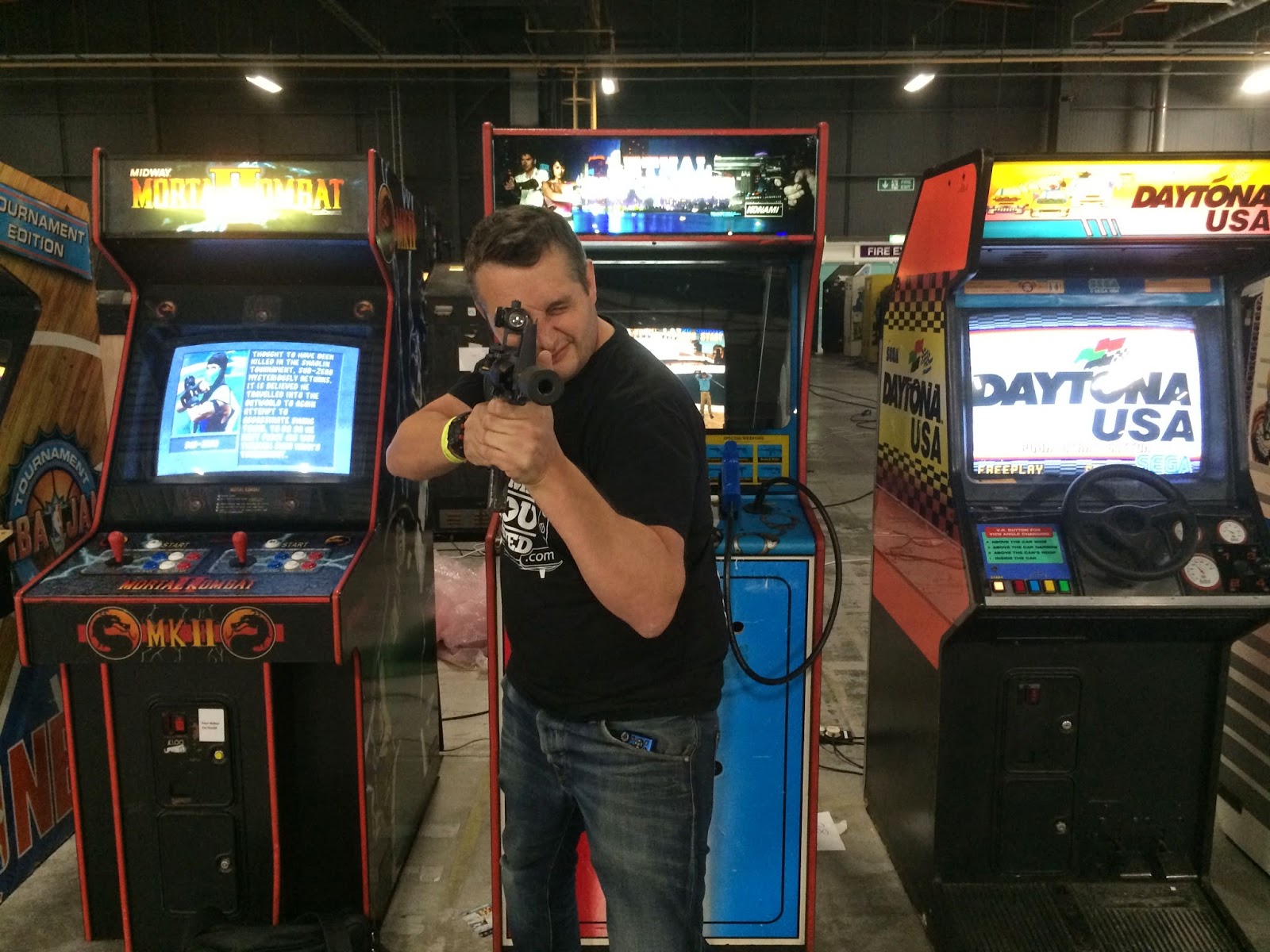
Sunday morning at Play Expo went a lot more smoothly without car worries to hold us back. The Games You Loved team got through the doors as early as possible, quickly unveiled our stand and hit the arcades for some cheeky games before the doors opened

I greatly appreciated the chance to try Smash TV and Tatsujin – two games I’d only heard of and would never usually get the chance to play, let alone see them in an arcade cabinet where they belong. As a younger generation gamer myself, experiencing all the 80s arcade machines in all their glory was a real privilege. The only thing I’d seen like it was Funspot, the American arcade featured in the movie King of Kong so it was a bit like standing on hallowed ground.

Forgive me for being a bit biased towards shoot’em ups but I have an unhealthy love for the genre, so here we go. I was able to play a real Galaga machine for the first time ever! Seeing the solid foundation behind the games I love was very cool, Galaga has definitely aged well which is probably why the series continues to this day. The same awe from playing on a real machine hit me when I tried Sinistar as well, it’s amazing to see how an old arcade game can be as intense an experience as Sinistar is.

Hanging out beside my beloved Progear cab while waiting for a turn gave me a chance to take in the friendly atmosphere of Play Expo. Shared passion makes for easy conversation and after a couple of attempts at my mission from yesterday I finally cleared the game on a single credit, and people who’d seen my efforts were quick to approach afterwards, have a chat and ask for advice about the game.

Day 2 brought out my competitive streak, even if that meant losing to Chris from the GYL team at Kung Fu Master, something I’m sure he’ll remind me of forever!


Alongside all this was a massive walkabout with Chris and a few of the other GYL team and some cool chaps in the community. When it came to arcades from Star Wars to Outrun you could pretty much take your pick.

I spent some time challenging people at Street Fighter games on the SNES, you have to respect the amount of time and energy these guys ‘n’ gals put into learning their fighting games, some of these brawlers were seriously good. I entered 8bit Planet’s Smash Bros Melee tourney despite being a pretty average player myself. 

Just watching the physical act of pressing buttons quickly was impressive enough; the better players’ hands were just a blur of movement and the game was being played so fast that a non-initiate probably couldn’t tell what was going on. As for myself I had the rare pleasure of actually winning a couple of matches before being knocked out of the third round in some really close games. One of my opponents was so good at mind reading he could tell everything I was going to do before even I knew, impressive stuff all round.

Some more exploration led me to a new indie game for Xbox 360 and PC called Tiny Keep, which invited me to begin my ‘tiny escape’. It’s a roguelike dungeon crawler with a charmingly cartoonish visual style that doesn’t detract from the game’s dungeon setting. You progress through randomly generated floors, hacking your way through enemies or leading them into traps. Once I figured out how to control my character I found it very fun, the random element is intended to keep players coming back for a varied adventure while each level has its own distinctive theme and boss.  My escape was cut short however when I ignored warnings to leave an ominous skull totem alone, disturbed it and was mowed down by a sudden ambush of skeleton warriors. As a gamer it’s hard to avoid interacting with any given object, but I definitely learnt my lesson.

Finally I tried out a retro arcade classic born anew on the Occulus Rift: Tempest! This was my first time trying the Occulus Rift for any type of game, so allow me to state the obvious; that it’s pretty damn cool. I won’t overdo it though. Even with the frantic shooter action of Tempest and its constant explosion of trippy colours, I wasn’t freaking out or having problems with my eyes afterwards like some testers have claimed. Somehow even in this crazy cyberspace disco, being totally immersed and having full use of my peripheral vision just felt natural. After trying Tempest I do wonder how I’d be affected by an Occulus Rift game that makes use of visual realism.


By Ben Cataldo
GamesYouLoved


Saturday, 13 September 2014

Putty Squad to get a physical Amiga release after 20 years!

Set to be used as special pledges in an upcoming Amiga book Kickstarter campaign, 100 physical replica copies of Putty Squad for the Amiga are set to be produced!

These 100 copies will come in authentic replica packaging on actual Amiga floppy disks. Bitmap Books have gained exclusive permission from System 3 to produce these copies of Putty Squad and will work with them closely to ensure that the final packaging is as near as possible to how Putty Squad would have looked if released in 1994.

50 of the 100 copies will be signed by the original Putty Squad development team.


Commodore Amiga: a visual commpendium
Commodore Amiga: a visual commpendium is Bitmap Books follow up to their hugely popular debut book; Commodore 64: a visual commpendium. Following on from the C64 book, the Amiga book will focus on the visual side of the computer featuring stunning pixel art, game maps and box art. It will also showcase the best software houses on the Amiga and is set to feature the Amiga demo scene.

The Kickstarter campaign starts on the 13th October and runs for 30 days. So far, some really exciting contributors are lined up and Commodore Amiga: a visual commpendium is set to be Bitmap Books biggest project yet.

Sam Dyer of Bitmap Books says ‘Putty Squad remains the Amiga’s most famous unreleased game. To be able to take Galahad’s 2013 release and produce physical copies of the game is hugely exciting. Huge thanks to System 3 and Galahad for allowing this to happen.”


About Putty Squad
Putty Squad was developed by System 3 and the follow up to 1992’s insanely good Putty. Set to be released in 1994 but this famously never happened due to the twindling Amiga market, but a pretty much full game remained in the System 3 archives. Fast forward 20 years and thanks to English Amiga Board member Galahad, in 2013 a version was released as a Christmas gift on System 3's website as free digital download.


About Bitmap Books
A new publisher specialising in beautifully designed and produced books all about video games. Commodore Amiga: a visual commpendium is the second book by Bitmap Books.

www.bitmapbooks.co.uk

Follow on Twitter @mrsidc64

Thursday, 17 April 2014

A New Retro Gaming Movie - FIZZ! The Surge of Video Games

Fizz! The Surge of Video Games is a unique 90 minute retro video gaming documentary movie made with lost and unseen archive footage which was filmed between 1989 & 1998.

All of the video had been originally shot to TV broadcast standard and the tapes have been carefully kept,restored and enhanced for maximum ouput quality. All of the broadcast formats which the footage has been kept on are now obsolete.Sony Betacam SP,Panasonic MII and Sony BVU SP were all broacast high quality recording video formats for TV in the last 1980's and early to mid 1990's.These were all analogue tapes, the cameras and recorders were all 4:3 aspect ratio and there was no digital recording available anywhere on computers.

This was an era before widescreen TV,16:9,HD,DVD.computer editing and the Internet.The only storage device for video at the time was on a VHS video cassette.

Fizz! The Surge Of Video Games is pure retro.The stories are told using 22 interviews filmed between 1989 & 1998 with key people who were working in the business back then.Games developers,marketing people,console manufacturers,retailers,Games chart research,trade bodies,games publishers.The big names in games back then are all included.Sony,Sega,Electronic Arts,Philips,3DO,Virgin Games,Mindscape,Interplay,Codemasters,Psygnosis,David Perry,HMV.Plus many notable video and audio appearances from some very familiar household names.

Fizz! The Surge Of Video Games tells the story exactly as it was because it was filmed as the marketplace and business evolved over a nine year timeline.

Beginning with momentum in the established 8 and 16 Bit era with a strong presence from the Commodore 64,Spectrum,NES,Sega Megadrive-Genesis, Atari ST,Amiga & SNES.This was a console and home computer gaming sector when titles were published on cartridge and floppy disk.Using interviews & footage filmed at the time,the documentary discusses how it all grew and then the problems which lead to the eventual decline.

As the 1990's wore on,new CD-Rom formats began to arrive, and an almighty hardware & console battle began to escalate.Established names such as Sega & Nintendo now faced competition from hardware heavy weights Panasonic,Sony and Philips who were all looking for a slice of the action.

It was also an era of progress and change as games developers who'd established 2D games and genres now faced a challenging prospect in a new world which would be three dimensional.


CD-ROM also saw the arrival of 'Edutainment'.A whole new genre where the vastly improved storage capacity of Compact Disc meant that people could play games and learn at the same time.

Watch Sony's first ever game launch filmed in 1993,two years before Playstation. There's a host of unseen promotional videos with celebrity appearances and a theatrical party event showcasing a now massive game franchise. 

Meanwhile on the PC there was the arrival of WIndows 95 which promised the end of DOS and the dawn of a stable platform backed by Microsoft.Hardware technology powered ahead with faster processors and 3D graphics cards fuelling high end games to rival any console.

This is a piece of modern history using 100% brilliantly shot,lit & edited archive footage with an excellent voice-over. 

Fizz! The Surge Of Video Games will be produced in English,French,German, Italian, Spanish, Japanese, Portugese, Norwegian, Swedish, Finnish & Danish languages.Worldwide release Summer 2014.  

A KickStarter campaign will be announced very soon.


Press email contact: media@fizzmovie.com 

Thursday, 20 March 2014

So You Wanna Be An Arcade Gamer?!

Emulation's What You Need 
By David Campbell


Emulation. Love it or loathe it, it is a means to an end for many a gamer.
Be it due to cost of collecting the real systems and associated paraphernalia, or be it due to restricted space, emulation is the gateway drug to a full on retro gaming habit.

Getting access to emulators for almost any retro system is a mere Google away, and once you find the rom images of your favourite game, the floodgates open.

"Oh, man, I remember that one.. and that- I used to love that one too!" is how it starts. 

Before you know it, there are external hard drives filled with every system imaginable and complete rom sets of every game, even the ones you've never heard of!

This has never been truer than in the case of MAME.

All of a sudden, these hulking machines that you loved as a kid, and never dreamed you could own - are now available to you, and are only a couple of mouse clicks away.

Getting MAME up and running is a pretty simple affair. and in no time at all, you are playing through some of your favourite games, and for a while it feels great.

But them you realise, it just doesn't feel right.

Arcade games were never played sitting in front of a keyboard. Hitting a key numerous times to fill the game with credits is not satisfying.

This unlocks something in you, and you start down one of three paths.

One - if you have the space (and the money), you might buy a couple of real arcade games. This will soon multiply and your house will soon be overrun with a multitude of cabs.

Two - you see about getting a MAME cabinet. You might save and buy a MAME cabinet from someone, maybe even buy a custom built one.

Three - and this is the most satisfying - you design and build your own MAME cabinet.

I went for the third option.

Framing Supports
Now, I realise not everyone has the skill, tools, or time to build their own cabinet. Let me start off by saying that I'm no carpenter - I can cut a pretty straight line and I'm good with wood filler :)

I spent about 6 months researching and designing my cabinet. Its not something you can do in a weekend. There are a few stages to it (if you want to do it properly), and I'd like to share my experience with y'all, in case it helps you in some way.

The first thing I did was decide on the type of cabinet I'd build. I grew up in the "golden age" of arcades, and as such I wanted my cabinet to have a traditional, old school feel to it. I wanted it to have a proper coin mechanism too, and I knew I wanted a classic style coin mech (more on that later).

Take a look at Jakobuds website (http://www.jakobud.com/plan-list.php) for some inspiration. I settled on a customised Taito style cabinet, reminiscent of most of the games from the early 80’s. You may be slightly younger, and your memories will be of Street Fighter II, Mortal Kombat, Virtua Fighter and the like. It really is up to you.

Once I knew the look of the cabinet I wanted, I started on the the part of the design that took the longest - the control panel.

Taking Shape
The only real trouble with a MAME cabinet is that it plays virtually all the arcade games you can think of. That might not sound like much of a burden, but arcade games had a plethora of unique controls to try and prise your pocket money from your sweaty palms. 

Here's just a  starter list of control types:
- Joysticks
- Trackballs
- Light Guns
- Spinners
- Rotary Sticks
- Steering Wheels
- Flight Yokes
- Twin Sticks
.. and there are a lot more besides this.

You can’t have all controls on your panel (and please don't try!), so I would recommend making a list of games you absolutely want to have in your cabinet.

List the control styles (you can check somewhere like the Arcade Museum if your memory is a little hazy - http://www.arcade-museum.com/) for each style of game, and decide what you can fit on your panel.

Control Panel Test
After much deliberation, I decided that I'd have a one player control panel, as it would only be me playing it 90% of the time. This comprises an 8 way joystick, and six buttons (more than enough to play Street Fighter etc). I knew I wanted a Trackball as I love Missile Command and Rampart. I added a second 8 way stick - not for a second player, but for games such as Smash TV, Karate Champ and Robotron.

For the icing on the cake, I also put two buttons on the side of the cabinet, which are flipper buttons for virtual pinball.

One other thing I decided on was that I wanted to be able to swap control panels, if I ever decided to make more specialist panels (driving or Ikari style, for example).

You also need to consider the monitor for your cabinet.

Purists will want a CRT, but these are hard to come by, large, and mey need repairing at some point. I put a 19" 4:3 (i.e. "square") monitor in mine, as most of the games were not widescreen back in the day.

At this point it may be worth mentioning that I use a PC to power my arcade cabinet.

However, throughout the design phase, and right up to the very end, I actualy designed the cab to run from an Xbox, Dreamcast and Playstation 2, using retail compilation discs. This allowed me to play 99% of the games I wanted to to, including light gun games (which generally need a CRT TV).

Paint it black
However, I opted for the PC in the end as it let me play 100% of the games I wanted, and then some!

There are pros and cons to the games console vs PC - its really a matter of personal choice for you.

Now, to interface real arcade controls with your computer (or console), I whole heartedly recommend what I consider to be the best interface on the market - the KADE (http://kadevice.com/). I've bought four of these beauties for various projects. They are inexpensive, straightforward to wire, and are customisable - they are USB powered, so easy to install!

Once you have your design, and I really would urge you to spend a lot of time on the design - no point building a cabinet that you don’t like or wish you had done differently- its time to actually build it.

There are many options and opinions on the best materials to use to build a cabinet. I opted for 25mm MDF for mine. Some people may be horrified at this, but its easy to work with, durable, and can take a battering!

It took me a week from start to “finish” to create my cabinet. You’ll need at a bare minimum the following tools:
  • Circular Saw
  • Jig Saw
  • Drill
  • Screwdriver
  • Hole Saw

Beta Testing
Take your time cutting the panels. Its easier to take a bit longer with no mistakes than to rush and have to fix a mistake!

Once all your panels are cut, Take the time to ensure that the base and sides are square. If they’re off at all, your cabinet will wobble and the control panel won’t fit properly.

Like I’ve said before - take your time!

Once all the parts are assembled, you need to paint it. This will take the longest time because you need to allow the paint to dry (obviously!), but you also need to do many coats to get a good finish.

I sanded the whole cabinet then wiped down with white spirit prior to priming to ensure the best surface possible.

Prime the whole cabinet with MDF primer. Don’t skip this step or scrimp by using cheap primer - MDF is like a sponge and will absorb paint, so primer it with proper primer to seal the pores and give you a good foundation.

Once your first coat of primer is dry, lightly sand it back with a medium grade sandpaper. This will allow your second coat of primer to fill any minuscule bumps (which look huge once painted!) and give you a nice finish. Wipe down the whole thing with a damp cloth and allow to dry before applying the second coat.

For me, two coats of primer was a good base. I painted my cabinet gloss black - obviously you can paint yours in any way you like. The process of painting was the same as the primer - paint, sand, wipe, paint.

I used a mini foam roller to paint my cabinet. Some people prefer brushes, but the roller gave my cabinet a nice texture that I liked - some people might not like that and prefer a totally smooth finish.

These decisions are the benefits of building your own cabinet!

Here’s a quick overall list of materials I used in my cabinet:
  • Three 8’x6’ sheets of 25mm MDF
  • one 750ml pot MDF primer
  • one 750ml pot black one coat gloss
  • one 36x36” sheet MDF for monitor cover and marquee

Hopefully this gives you an overview of building your cabinet.

There are many great resources out there, and here are a few that helped me immensely:


Have fun, and if you’ve any questions, get in touch and I’ll try to help!

Guest BLOG by GYL Fan - David Campbell