Showing posts with label clive sinclair. Show all posts

Friday, 19 September 2014

A 1980s childhood brought to life - A book review

GamesYouLoved synopsis: 
Diary of an 80s Computer Geek
By Steven J Howlett 
As a child growing up in the 80s you would have seen dramatic changes occuring in technology along with music, movies, toys and fashion.  

In the Diary of an 80s Computer geek, Steven J Howlett brings this to life through the eyes of a child and the world around him changing before him. 

The wonderment of change and a life dedicated to computers started early for our protagonist. From the longing for the simple ZX81 in 80s Britain, where the individual had a chance make something from new if they really wanted. To the idea that this could even be a job or career.  Could this 'hobby' of computers and gaming become something more?


From the playground where cassettes could be bought and sold on the black market, to programming line after line of code to create simple games Stephen was on a journey that no other generation had encountered. 

This diary takes you through the 1980s with how Steven dabbles in ventures which from a simple hobby using the ZX81 becomes more to him as the years go by. 

We won't spoil the overall plot and detail, but some of the highlights of the story are as follows:

- upgradings of one machine to the next and what this meant at the time!
- computers at school and the games you loved and played
- computer magazines and how we trusted and cared for them
- the evolution of computers from 8-bit to 16-bit, and the high and lows of this

In summary when reading this book - cast your own mind back and think about computers and video games in the 1980s - what kind of memories does it conjure up? 

It might be quite different depending where you are in the world but nevertheless it was a time of great innovation and ground breaking products.  There was also an air of mystery around gaming and computer companies in the very early 80s - with no internet we relied on magazines, newspapers and limited TV channels to serve up information and in some countries (including the UK!) it came much later than 
others such as the USA and Japan. 

Whatever memories you had - the Diary of an 80s Computer Geek is sure to unlock some happy thoughts and will having you looking on ebay or googliing after reading it!

Diary of an 80s Gomputer Geek is available in print format & digital format here:
http://www.amazon.co.uk/Diary-80s-Computer-Geek-Computers-ebook/dp/B00JYGGCTO
http://www.amazon.com/Diary-80s-Computer-Geek-Computers-ebook/dp/B00JYGGCTO

You can also follow it's author Stephen on Twitter here: @sj_howlett  

Wednesday, 6 August 2014

Arcades - The Scene ain't dead

Back in January 2013 a friend and I were discussing what would it take for arcades to be revived in the UK. 


We agreed there would need to be two fundamental differences from the arcades we remember. The first requirement was that the Coin-Op system has to go. I’d love to know how many pound coins I burnt through as a kid, constantly nagging my parents for another go on Time Crisis 2 and never making it past the first stage. The other requirement was the venue having a sense of community, a hangout spot in which patrons feel involved in the venue’s future. 

Little did I know that shortly afterwards The Heart of Gaming would open and surpass those expectations. It’s located in North Acton, half an hour’s tube ride from central London and 10 minutes to walk there. 

All the machines are set to free play: you pay a flat rate on the door and can game to your heart’s content, a different experience from the arcades of yesteryear. This obviously suits hardcore gamers down to the ground; there was a time I couldn’t tell a shoryuken from a shuriken, but now after some day long sessions and meeting people there I’m a pixelated murder machine. That’s one of the amazing things about The Heart of Gaming, there’s plenty of scope for people to chill out and meet other gamers: shared passions are a roundhouse kick to the face of social inhibition. The same is true of any hobby, but it’s pretty damn cool to know there’s a place where who or what I am doesn’t matter, who I am is how much ass I kick at Ikaruga.

Immediately upon entering the venue you’re greeted by the sight of 6 Versus City Arcade Cabs. These are the Japanese style, with the game’s video replicated on two back to back monitors, the players unable to see each other while sitting, which is a pretty rare set up in the UK. 

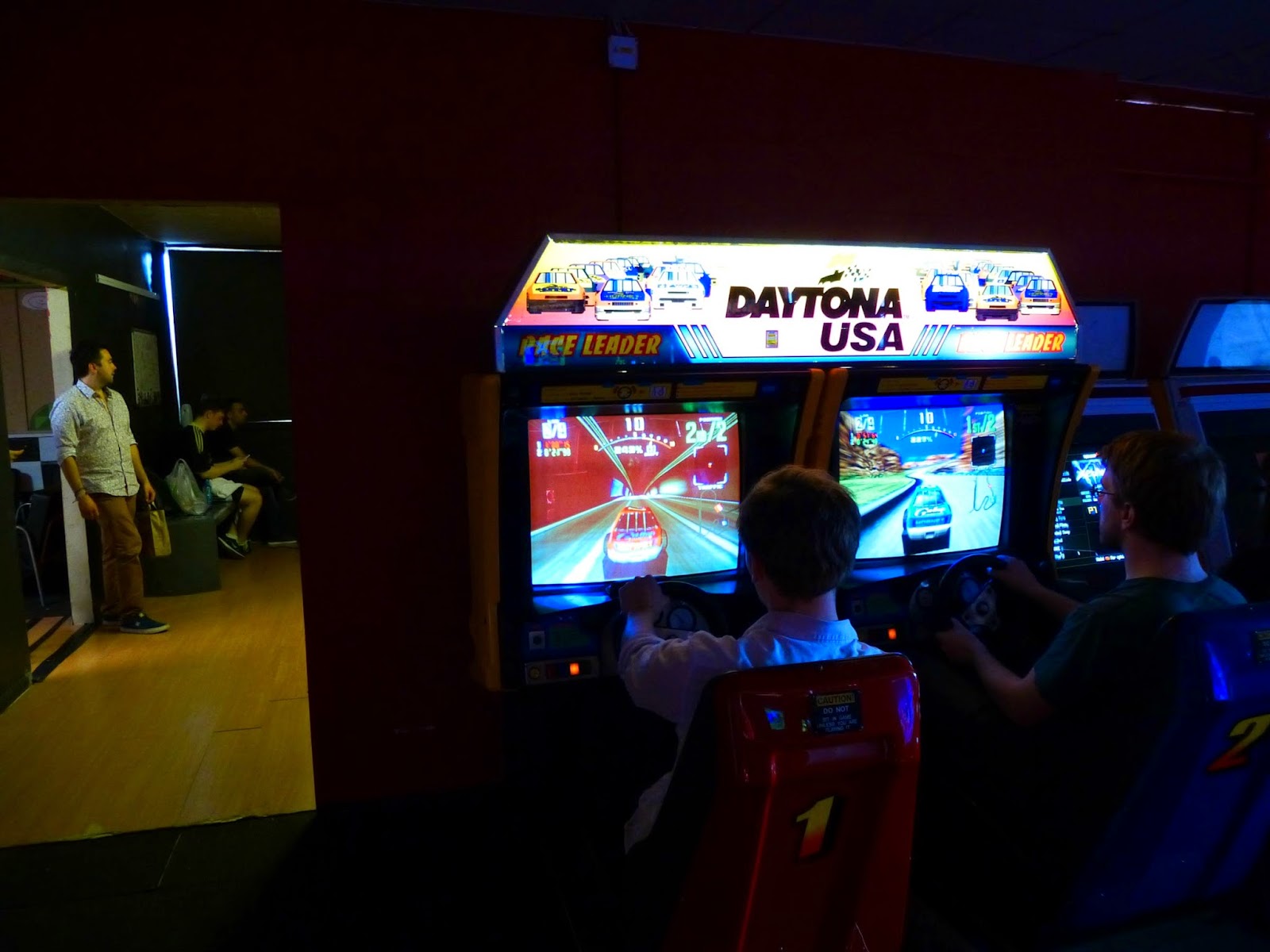
This is the arcade room, with Sega Naomi cabs lining the walls, House of the Dead, Fighting Mania, the racing game Daytona USA and a couple of custom retro cabs that cycle between the likes of Donkey Kong, Space Invaders, 1942 and Pacman. Time Crisis 2 has made an appearance too, so I can finally avenge my parent’s wallets. Many of these cabs were rescued from London’s dying arcade scene, places like the Trocadero and Casino Arcade after they closed their doors. For shooters, Naomi titles like Border Down and Shikigami no Shiro 2 hold sway. A great thing about this room is there’s usually some obscure game I’ve never heard of before, like Money Puzzle Exchanger or Xexex. Visitors don’t need to worry spending their money on an unfamiliar machine, as they’ve already paid to get in and can try the games for free. In fact I’d recommend trying everything you see.


Moving onward there’s two little rooms, the first of which is dedicated to a dance machine. After that is a lounge area packed with retro consoles: Super Nintendo, Sega Megadrive, N64 and Playstation with games you can get from the front desk. The last area the HoG has to offer is the console room. There’s roughly 20 flat-screens with as many consoles set up here set up here for PS3 and 360 Gamers as well as a Wii U and some couches to make up a chill space in the middle of the room. Little crowds of gamers are usually in here huddled around their platform of choice, usually doing rotation for a fighting game. The corner has a couple of desks and monitors ready to provide live streams of any tournaments the HoG is running online at www.twitch.tv/thewonderpark. These are usually a wild assortment of fighters but sometimes it’s a dance game.

Tournaments are a huge part of the HoG, the sense of involvement and reward you get from offline competition, whether friendly or for higher stakes is something that was lost in translation when multiplayer gaming shifted to online play. The venue’s roots are in the fighter scene and it’s through these tournaments that community involvement is fostered. There’s always a big turnout for Street Fighter and Tekken showdowns, but an arcade makes for a much needed break from gamerdom’s obsession with new.

As such, there are older games developing large competitive scenes, like Street Fighter III: 3rd Strike and Super Smash Bros Melee; games which are over 10 years old. Upwards of 200 people have been known to turn up for Smash tourneys and the whole place is both transformed by that energy, and physically transformed when HoG staff set up loads of CRT displays to accommodate the demand for more smash setups.
A favourite of mine is seeing the Dance games community show up in force. They arrive equipped with towels, bottled water, crates of coke and order pizza in bulk once they’ve worked up an appetite. Those guys ‘n’ gals move their feet faster than I thought humanly possible and get unbelievable scores.


The HoG’s strength lies in its versatility. The front reception now doubles as a trade-in shop, offering fairer prices than you’ll see in high street stores, as well as some pretty rare finds. A Rock Band and projector setup appears in a spare corner from time to time, and there are plans to introduce PC setups and a bar.

The Heart of Gaming provides people who missed out on the golden age of arcades to experience a similar atmosphere, or for veterans looking for that nostalgia factor it’s a welcome throwback to the good old days. At the same time offering a base for modern game scenes to have their meets and tournaments is a way to remain in the present too. Places like these are timeless, I love the HoG and with enough support it should be here for a long time. 


HoG manz since day 1
By Ben “Blinge” Cataldo - guest reviewer and blogger for GamesYouLoved.com

Check out the BlinJe channel here too: http://bit.ly/1lAtxc2

Tuesday, 5 August 2014

Commodore & Amiga - EXCLUSIVE

We caught up with Sam Dyer at the point of printing his new Commodore 64 book at the printing press to see what his views on the Kickstarter success are and to the future with his Amiga book


Q. now you are at the proof stage how real does this all feel to you now? 

Sam:
It still feels massively exciting and I can't wait to hold an actual book. I think it will be surreal to actually hold one as I've dreamt of doing for so long! But I've loved every minute of the campaign. From initial concept,  promotional stuff,  kickstarter and the actual design it has all been a blast! 

Q. seeing the proofs now are there any spreads / games in the books that really stand out for you? 

Sam:
My favourite spread had always been Total Recall. Stephen Ian Thomson's pixel art in that game is stunning. Too see his image of Cohaagans eyes popping out on Mars across a double page spread is a joy to behold! The game maps have also come out really well and the detail picked up by the print is fantastic.

Q. how do you as a designer feel about this being your own hard work that is coming to light - a reality now?

Sam:
It feels very odd to be honest! I've worked on the book every night for the last 6 months in some form or another and it really has been a labour of love! To answer your question,  it's a mixture of excitement (and relief!). But most of all I feel proud of what I have created. 

Q what would you like to say to the community out there who has supported you? 

Sam:
You are ALL amazing. I have been seriously touched by the support I've had from all corners of the retro gaming community. Everyone has been so kind and to be honest, none if it would have been possible without this support. I must also say a huge thank you to a few people that have given up their own time and have been giving me advice along the way. So huge thanks to everyone at GYL, Andy Roberts, Mat Allen,  James Monkman and Steve Jarratt.

Q what is it about the Commodore 64 book that made it your first gaming book to focus on? 

Sam:
It was my first computer as a child and the one I remember with the most fondest memories. Also I felt there was a gap in the market for a visual book on the C64. It hadn't been done before and that appealed to me massively. I also knew that the C64 had a very active scene so drumming up interest would have been easier than picking a niche computer with a limited fan base. And most importantly,  I'm a HUGE fan of pixel art and the C64 has some of the best ever (in my opinion!)

Q. what have you learnt managing the kickstarter - positive and negative - any tips? 

Sam:
Ive learnt LOADS. I made some mistakes but I've learnt from them. Starting a small publishing business and running a Kickstarter was a huge learning curve for me and I must give a huge thanks to Tim Nicholls here. Tim ran the hugely successful Artcade book campaign and he very kindly gave me lots of advice at the start. This advice gave me the confidence to 'go for it'. Cheers Tim!

As far as tips go... I would say: Before launching your Kickstarter, spend a couple of months, drumming up interest,  join relevant forums, gaining a following on social media and produce a promo video. That way, when launched, you will already have done a lot of hard work around promotion and getting the word out there. People will not find you,  you have to find them. Get your numbers right! Do all the maths before you begin and set your total. Take into consideration all outgoings and TAX etc... by getting your numbers right, it means you won't have to stress about this side of things and can concentrate on enjoying the campaign.

Don't rest once funded! The C64 book was funded after only 1 week and it is natural to maybe take your foot off the gas and think 'Ive done it!'. It was at this point I had some fantastic advice from a friend that I should push on and make the campaign even bigger and better. "Don't stop now" he said. "Release some exciting stretch goals, more pledges and keep pushing the campaign 100%". Im so glad I took this advice as it really gave me that final push to make it as successful as it was.

Q give us some juicy gossip about the forthcoming Amiga book you have planned?

Sam:
OK! The Amiga book will be next book in the Commpendium series. It will follow the same style as the C64 book book and will act as a kind of big brother (or sister) to it. As far as gossip goes,  I have been working behind the scenes with Matt Wilsher on ways to make the Amiga campaign even bigger and better then the C64 one. 

All I will say is that we will be resurrecting a famous unreleased game as a physical product. Printed box, instructions and actual floppies. That is all I can say at the moment, all will be revealed soon!

To order the C64 book go here: http://www.bitmapbooks.co.uk/
To follow Sam on twitter to find out more about the C64 book and hear the latest on the Amiga book go here: https://twitter.com/MrSidC64

Tuesday, 24 December 2013

EXCLUSIVE Bluetooth ZX SPECTRUM KICKSTARTER Interview with Elite Systems Managing Director, Steve Wilcox

So Steve - thanks for taking time out at the beginning of this exciting time with the launch of your new Kickstarter. But this isn't something new for you creating new technologies and games for the industry.

Firstly lets talk about Elite and its History....

Q. Tell us about your role at Elite - Steve from the beginning and to now?


Steve Wilcox
Well, I’m a de facto co-founder of the company, having been a Director since it’s formation on 14th August, 1984. Consequently, I’ve been involved – in some way - with every glorious (and every inglorious) moment of Elite’s 29 year history.

Q. How and why was elite founded?

Steve Wilcox.
Although I’m a co-founder, that’s really less than half of the story. The real source of Elite’s foundation was my much younger and somewhat smarter brother – Richard. In 1982/3, at the age of 14/15 he wrote – first for the Atari 400 and subsequently for the ZX Spectrum – a TV-series inspired game, featuring a helicopter. It was called ‘Blue Thunder’ and was marketed using the label ‘Richard Wilcox Software’. Our father, Brian, backed Richard’s work with full-colour, full, page advertisments in Computer & Video Games magazine, amongst others. At that time, I’d just left my one and only post-University employment to set up and independent retail outlet specialising in the sale of ZX Spectrum software and hardware. It traded as “Bowies: The ZX Spectrum Specialists”. Richard’s game needed selling into the retail channel, in those days that meant Boots, WH Smith et al. So, between serving customers in our “mom and pop” store, I doubled as Richard’s telesales team, eventually selling around 40,000 copies ohf his game. A little later, four young guys set up camp in the store room of our shop and began working on a ZX Spectrum game to follow Richard’s (and the first to be published using the label ‘Elite’). That game was called ‘Kokotoni Wilf’.


Q. What were the highlights of the 80s and gaming for you personally?

Steve Wilcox.
Those very early days, ‘83 to ’87, were a blizzard. 7 days a week. 12 hours a days. Phones. Planes. People. Products … and several million games sold. Looking back it’s hard to recall how we crammed so much in to such a short period. Half a dozen UK and European #1-selling games, Game of the Year, Software House of the Year, zero to one hundred staff.

Q. What was the process of developing and publishing games like in the 1980s?

Steve Wilcox.
A lot like developing and publishing apps today (… and absolutely nothing like publishing console games today). ‘Have an idea in the morning, be working on it in the afternoon, start marketing it the following day, have it in players’ hands the following month, (sometimes). A fantastically liberating, exciting and enjoyable way to earn a very good living, (if you were very lucky).

The Now...2013

Q. What has inspired you with this new Kickstarter?

Steve Wilcox.
The inspiration for the development of the Bluetooth ZX Spectrum device was a series of conversations with a national journalist in the Spring of 2011. At the time, the journalist was the Consumer Technology Editor for a British National Newspaper and called to talk to us about the range of original 1980s ZX Spectrum games which we’d relatively recently launched as apps for iOS devices. During the conversations he enquired whether we thought there was any possibility that the ZX Spectrum home computer might be recreated. At the time we spoke about how another 1980s home computer, the Commodore C64, had had a re-launch of sort in the form of a dedicated joystick (you can read about that device here) and that got us thinking. After talking about it in the office for a few minutes, our vision for how the ZX Spectrum could be recreated began to take shape. We called the journalist 30 minutes later and two days after, his account of our vision appeared in the article which he wrote. You can read that article, which created quite a stir at the time, here.

Q. How important was the keyboard to the ZX Spectrum - both in design and functionality?

Steve Wilcox.
I think Rick Dickinson, Industrial Designer at Sinclair Research in the 1980s and the man credited with the external look of the ZX Spectrum, best explained the importance of the keyboard to the design and functionality of the ZX Spectrum in the video which he recorded for our Kickstarter appeal. It lasts 5 or 6 minutes but is incredibly insightful. I’d recommend anyone interested in the device to watch the video.


Q Tell us about the existing games that can be played in unison with hardware?

Steve Wilcox.
Well, in the first instance and as we’ve recently confirmed, we’ll be updating the ZX Spectrum: Elite Collection / HD apps so that they’re compatible with the Bluetooth ZX Spectrum. For iOS device owners who’ve already invested in these app, that means that they’ll be able to play the 200 or so ZX Spectrum games which they may already own using the Bluetooth ZX Spectrum. Optionally, the Bluetooth ZX Spectrum can be used as a Bluetooth keyboard not only for iOS but also for Android and Windows phones and tablets (as well as for PCs and Macs). That throws up a whole host of additional possibilities.

Q Will there be any new games coming out in 2014 to working in unison with the hardware?

Steve Wilcox.That’s a great question. As you may know, we announced earlier this year that we’re working with Matthew Smith (‘Manic Miner’, ‘Jet Set Willy’ for the ZX Spectrum) on a new project. Wouldn’t it be fantastic if the launch of the Bluetooth ZX Spectrum coincided with such a project? Also, since the announcement of the Bluetooth ZX Spectrum a few days ago, we’ve been approached by developers with proposals that we work with them on the development and publication of new games for the device. It’s still very early days but there are clearly many opportunities for developers to launch new games to coincide with the launch of the Bluetooth ZX Spectrum.

Q. Have you been in contact with any 80s developers and creative pioneers from the 80s in this new project or as part of developing mobile games?

Steve Wilcox.
It’s remarkable but the answer to your question is yes. In addition to Matthew Smith, Keith Burkhill (‘Commando’, ‘Ghosts n Goblins’, ‘Space Harrier’ for the ZX Spectrum has worked with us on the ZX Spectrum: Elite Collection / HD apps for iOS devices. He’s still very local to us, in the suburbs of Birmingham. Nigel Alderton, (‘Chuckie Egg’ for the ZX Spectrum) is still in contact too. We’ve been publishing ‘Chuckie Egg’ for mobile phone for almost 10 years and will do so again for the Bluetooth ZX Spectrum.
 
Q How has the games industry changed since 1984 - the good and the bad?

Steve Wilcox.
For the good - scale an certainty. When we first became involved in the games industry in the first half of the 80s there was still much comparison with “the Skateboard business”. At that time “the Skateboard business” was seen to have risen and fallen (it hadn’t yet risen again) and in some circles there was a fear/ expectation that a games industry “built on kids who had no disposable income” was just a flash in the pan. Thankfully, that’s no longer so. I’m struggling to think of ways in which the games industry has changed for the bad. If I was forced to pick on one then I’d say that the somewhat predatory way in which some developers / publishers elicit (sometimes large chunks of) cash from the young and the vulnerable, though in-app purchases, is a step in the wrong direction. Elite has not nor will it ever be involved in such activities.

Q. What are your favourite Spectrum games with keyboard play?
Steve Wilcox. 
‘Manic Miner’.